


Hey there! As a supplier of Threaded Pipe Fittings, I've had my fair share of experiences and knowledge about these nifty little components. Today, I'm gonna dive into the heat transfer characteristic of threaded pipe fittings.
First off, let's understand what threaded pipe fittings are. They're used to connect pipes in various systems, like plumbing or industrial setups. You can find different types, such as elbows, tees, and couplings. These fittings are designed with threads on the ends, which allows for easy installation and connection. If you're interested in learning more about the threaded joint in pipes, you can check out this link: Threaded Joint in Pipe.
Now, let's talk about heat transfer. Heat transfer is all about how heat moves from one place to another. There are three main ways heat can transfer: conduction, convection, and radiation. In the case of threaded pipe fittings, conduction is the primary mode of heat transfer we're concerned with.
Conduction happens when heat is transferred through a material by direct contact. When it comes to threaded pipe fittings, the material of the fitting plays a crucial role in how well it conducts heat. For example, stainless steel is a popular choice for threaded pipe fittings because it has good heat conduction properties. You can take a look at our Stainless Steel Threaded Pipe Nipple to get an idea of what I'm talking about.

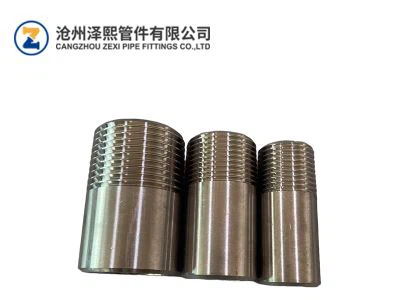
The design of the threaded pipe fitting also affects heat transfer. The threads on the fitting increase the surface area in contact with the pipe, which can enhance heat conduction. However, the tightness of the threaded connection is also important. If the connection is too loose, there may be gaps that can reduce the efficiency of heat transfer. On the other hand, if it's too tight, it could potentially damage the fitting or the pipe.
Another factor to consider is the fluid flowing through the pipes. The temperature and properties of the fluid can influence the heat transfer process. For instance, if the fluid is a good conductor of heat, it can help transfer heat more effectively through the pipe and the fitting.
In some cases, insulation may be used around the threaded pipe fittings to control heat transfer. Insulation can prevent heat loss or gain, depending on the application. This is especially important in systems where maintaining a specific temperature is critical, such as in heating or cooling systems.
Now, let's think about the applications of threaded pipe fittings and how their heat transfer characteristics come into play. In a plumbing system, for example, the heat transfer properties of the fittings can affect the efficiency of hot water distribution. If the fittings conduct heat well, the hot water can reach the desired locations more quickly and with less heat loss.
In industrial settings, threaded pipe fittings are used in a wide range of processes, such as chemical manufacturing and power generation. The heat transfer characteristics of these fittings can impact the overall performance and safety of the systems. For example, in a heat exchanger, the ability of the threaded pipe fittings to transfer heat efficiently is essential for the proper functioning of the equipment.
As a supplier of Threaded Pipe Fitting, I know how important it is to provide high - quality fittings with good heat transfer characteristics. We test our products rigorously to ensure they meet the standards and requirements of our customers.
If you're in the market for threaded pipe fittings, whether it's for a small plumbing project or a large - scale industrial application, we've got you covered. Our fittings are made from top - notch materials and are designed to offer excellent heat transfer performance.
So, if you're interested in discussing your specific needs or have any questions about our threaded pipe fittings, don't hesitate to reach out. We're here to help you find the right solutions for your heat transfer requirements. Let's work together to make your projects a success!
References
- Incropera, F. P., & DeWitt, D. P. (2002). Fundamentals of Heat and Mass Transfer. Wiley.
- Holman, J. P. (2002). Heat Transfer. McGraw - Hill.


